
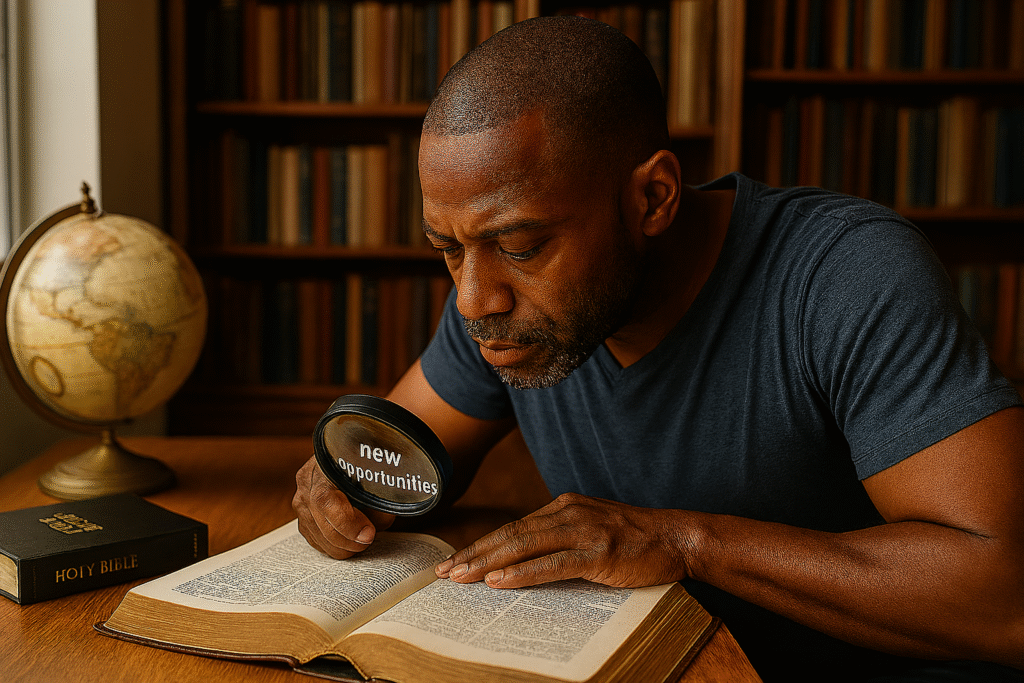
Seeking New Opportunities
Trusting God’s Timing and Leading
Every man faces moments when new possibilities arise. The challenge is learning to discern whether it’s God opening a door or simply our own desire for movement. This reflection encourages us to balance faith with wisdom, involve our families in prayerful decision-making, examine our motives honestly before God, and learn to trust His timing — even when His answer is “not yet.” Through the examples of Noah, David, and Joseph, we’re reminded that God’s delays are never denials but divine preparations for what’s ahead.
Key Scripture: Proverbs 3:5-6
“Trust in the Lord with all your heart and lean not on your own understanding; in all your ways submit to Him, and He will make your paths straight.”
Other Scripture: Psalm 37:5–7; James 1:5
Exhortation
Every man faces seasons when the path ahead feels uncertain yet full of possibility — a new job, a shift in ministry, a new business venture, a relocation, a stirring in the heart to try something new. Sometimes it’s not even a change we seek, but one that finds us. In such moments, discerning whether it’s God opening a door or our own desire for change can be deeply challenging. The truth is, both can look the same at first glance — appealing, promising, even logical. But one leads to peace that endures, while the other often leaves restlessness after the excitement fades. The key is learning to pause long enough to ask, “Lord, is this You — or just me wanting movement?” That honest question alone often reveals where our hearts truly are.
Faith calls us to believe that God leads His people, but wisdom calls us to walk that faith with care. We sometimes pray for open doors without checking if we’re ready to walk through them. Balancing faith and wisdom is part of mature Christian living — doing our research, preparing diligently, and seeking godly counsel are not signs of doubt but of reverence. Noah didn’t just believe in the coming flood; he built an ark plank by plank (Genesis 6:13–22). Faith built it, but wisdom measured the timber. In the same way, when new opportunities arise, our confidence should not be in our eagerness but in our preparation and the Spirit’s quiet assurance that this step aligns with His will (James 1:5; Proverbs 16:3).
In all this, it’s vital to remember that we do not walk alone. Our families are part of our calling, not accessories to it. Too often, we wrestle with life-changing decisions privately, only to inform those most affected later. Yet, inviting our wives and children into the journey — asking for their prayers, thoughts, and peace — is part of spiritual leadership (Ephesians 5:25–28; Joshua 24:15). God often confirms His direction not only through Scripture or inner conviction but through the unity of the family. When peace rests on all hearts involved, it’s often a sign that heaven’s timing and direction are in harmony (Colossians 3:15).
But even deeper than decision-making lies the matter of motive. Why do we want this change? Is it to find rest from frustration, to gain financial stability, to earn recognition, or to obey a prompting from God? Motives can be complex, and God doesn’t despise our practical needs — but He weighs the heart (Proverbs 21:2). Many of the most painful detours in life arise not from wrong actions but from unexamined motives. It’s worth asking, “If God said no to this opportunity, would I still trust Him and find joy where I am?” That single question exposes whether our pursuit is born from obedience or impatience.
And when the answer comes — whether “yes,” “not yet,” or “no” — our trust is tested most deeply. God’s “no” is not rejection; it’s redirection. His delays are not indifference; they are preparation. David waited years between anointing and appointment (1 Samuel 16:1–13; 2 Samuel 5:3); Joseph’s dream was tested in the prison before it reached the palace (Genesis 37:5–28; Genesis 41:39–43). These men were not being punished but prepared. So when we’ve prayed, planned, and still face closed doors, it’s not defeat. It’s God saying, “Stay close. The story isn’t finished.”
In all seasons — of waiting, moving, or standing still — the posture that pleases God most is faith expressed through surrender (Psalm 37:5–7; Proverbs 3:5–6). He calls us not only to seek opportunities but to seek His heart in them. For the Christian man, father, and husband, the truest success is not in what door opens, but in who walks with him through it.
- How do we tell the difference between God opening a door and our own desire for change or advancement?
- We often pray for open doors, but how do we balance faith (“God will make a way”) with wisdom (doing our research, preparing properly, seeking counsel)?
- How can we involve our families in the discernment process rather than deciding alone?
- Why do we want this change — for financial stability, recognition, frustration, or obedience? How do we ensure our decisions reflect spiritual maturity and integrity, not impatience or pride?
- Even after doing our best, how do we take God’s “not yet” or “no”?
This week, take time to pray through one area of change or opportunity you’re considering. Write down your motives, involve your spouse or a trusted friend in prayer, and ask God not only for direction, but for peace, even if His answer is to wait.
“Lord, help me discern Your will in the opportunities before me. Teach me to wait patiently when You say ‘not yet,’ to walk humbly when You say ‘go,’ and to rest securely knowing that every season is guided by Your perfect wisdom, in Jesus' name, Amen.”